


 Schoolbags
 School supplies
 Figurines
 World of the house
 Choice of brands
Does your child have Golden on repeat and keep talking about Rumi, Mira and the Saja Boys? Discover the story behind...
Cart :
Shipping cost : 0,00 €
100% of orders processed in less than 24 business hours!
SALES: 5% immediate discount with the promo code: BBB
SALES: 5% immediate discount with the promo code: AAA
-
 SchoolbagsRolling Backpack For School
- Rolling Backpack Girl
- Rolling Backpack Boy
School Bag With Wheels- Wheeled School Bag Girl
- Wheeled School Bag Boy
School backpack- Backpack 1 compartment
- Backpack 2 compartments
Children's Schoolbag- Girl School Bag
- Boy School Bag
- Nursery School Bag
- School Bag Year 1
- Primary School Bag
Messenger bagSports bag- Girl Sports Bag
- Boy's Sports Bag
Pool bagLunch Bag- Girls' Lunch Bag
- Boys' Lunch Bag
Shopping bagPencil case- Kit 1 compartment
- Kit 2 compartments
- Kit garnished
A4 binder- A4 Girl Classer
- A4 Boy Classer
School calendarStationeryTrolley AloneSuitcase -
 School suppliesNotebooks
- Notebooks 24 cm x 32 cm
- Notebooks 21 cm x 29.7 cm (A4 format)
- Notebooks 17 cm x 22 cm
- Draft and writing notebooks
Correction and pencil cutters- Gums
- Proofreaders and erasers
- Pencil sharpeners
CalculatorsWriting- Ballpoint pens
- Fountain pens
- Roller pens
- Felt pens
- Highlighters
- Markers
- Pencils and pencils
- Cartridges and refills
Cutting and fastenings- Waterspouts and bedbugs
- Scissors and cutters
- Staplers and Perforator
Tracing- Menstruation
- Compass
Glue and adhesives- Glues
- Scotch
Filing cabinets and accessories- Dividers
- Punched pockets
- Filing cabinets small size
- 4-rings binders
- Lever binders
Diaries- School calendars
Copies, blocks and paper- squared paper sheets
- Seyès Ruled Exam Sheets
- Notepads and and paper
- Desk Memo Cubes and Post-it Notes
School packsView holders, shirts and sorters- Door-views
- Shirts
- Sorters
Labels and Stickers- Etiquettes
- Stickers
Good points boxesSlates, paintings and accessories- Slates and tables
- Markers and chalk
Drawing and music- Brushes, gouache, acrylic
- Paper, layer cardboard
- Colored pencils
- Music
- Felt
- Chalks
-
 FigurinesBetty Boop figuresStatuettes Betty BoopTiti FiguresCartoons figuresFigurines Leblon delienneFigurines Demons & MerveillesFigurines Michel AroutcheffGuillermo Forchino FiguresStatuettes Marilyn Monroe
 -
 World of the houseHouse linen
- Duvet cover
- Fitted sheet
- Polar Plaid
- Cushion cover
- Cushion
- Bath sheet
- Poncho
- Textile
Games - Toys- Toys
- Plush
Dishes- Mugs
- Bowls - Cups
- Glass
- Boxes
- Kitchen
Decoration- Metal plates
- Lamp
- Piggy bank
- Mirror
- Frames & photo frame
- Alarm clock
- Pendulum
- Bathroom
- Storage
- Door stickers
- Other decorations
Leather goods- Handbag
- Wallet
- Wallet
- Belt
- Umbrella
Accessories- Key ring
- Smoker
- Jewellery
- License watches
- Magnets
Gift by event- Birthday Gift
- Retreat Gift
- Valentine's Day Gift
- Mother's Day gift
- Father's Day gift
- Christmas gift
- Birth Gift
- Wedding Gift
- Original gifts
- Humorous gift
Gift vouchers -
 Choice of brands
Catégories de blogs
Rechercher dans blog
Derniers articles

KPop Demon Hunters: The Story, Characters and Global Phenomenon
Read more

The 10 Best School Bags for Year 1 in 2026: Our Top Picks for a Great Start Read more
Choosing a school bag isn't easy. Size, weight, durability and children's favourite designs all matter. We've...
Which schoolbag to choose according to age and class? The ultimate guide Read more
Check out our comprehensive guide to choosing the perfect backpack for your child!
Stuffed Animals Les Déglingos: Why Do Children Love Them (and Parents Too)? Read more
Funny animals, soft textures, comforting colors: discover why Les Déglingos stuffed animals are so popular with...

Mother's Day: give a Betty Boop figurine, the original gift that makes all moms fall in love! Read more
Looking for an original gift for Mother's Day? Discover how the charming and characterful Betty Boop figures can...
Articles populaires

Choosing the right size of your schoolbag: complete guide!
Tired of being fooled by the visual of the schoolbag in favor of the right size? Yes, but at the same time, no one...
Read more
Who is Stitch? Experience the endearing Disney character like you've never seen him before!
Are you intrigued by the endearing blue creature named Stitch that your child keeps talking about? Discover the story...
Read more
Paw Patrol Heroes: Names, Powers, and Secrets Revealed!
Who are the PAW Patrol characters? What are their roles and secrets? Find out all about these fearless puppies and...
Read more
Discover the incredible story of Spiderman!
Discover the incredible story of Spider Man! His origins and adventures will soon have no secrets for you. We tell...
Read more
The history of the Kipling brand or how the monkey became king of leather goods
Kipling: much more than just a bag! Discover the astonishing rise of this Belgian brand that has made a monkey the...
Read moreArticles en vedette
KPop Demon Hunters: The Story, Characters and Global Phenomenon
Does your child have Golden on repeat and keep talking about Rumi, Mira and the Saja Boys? Discover the story behind...
Read more The 10 Best School Bags for Year 1 in 2026: Our Top Picks for a Great Start
Choosing a school bag isn't easy. Size, weight, durability and children's favourite designs all matter. We've...
Read more Which schoolbag to choose according to age and class? The ultimate guide
Check out our comprehensive guide to choosing the perfect backpack for your child!
Read more
Top 5 bed linen for girls!
Your little girl's room doesn't really reflect her personality... It's time to fix it! The quick and easy trick to...
Read more Stuffed Animals Les Déglingos: Why Do Children Love Them (and Parents Too)?
Funny animals, soft textures, comforting colors: discover why Les Déglingos stuffed animals are so popular with...
Read more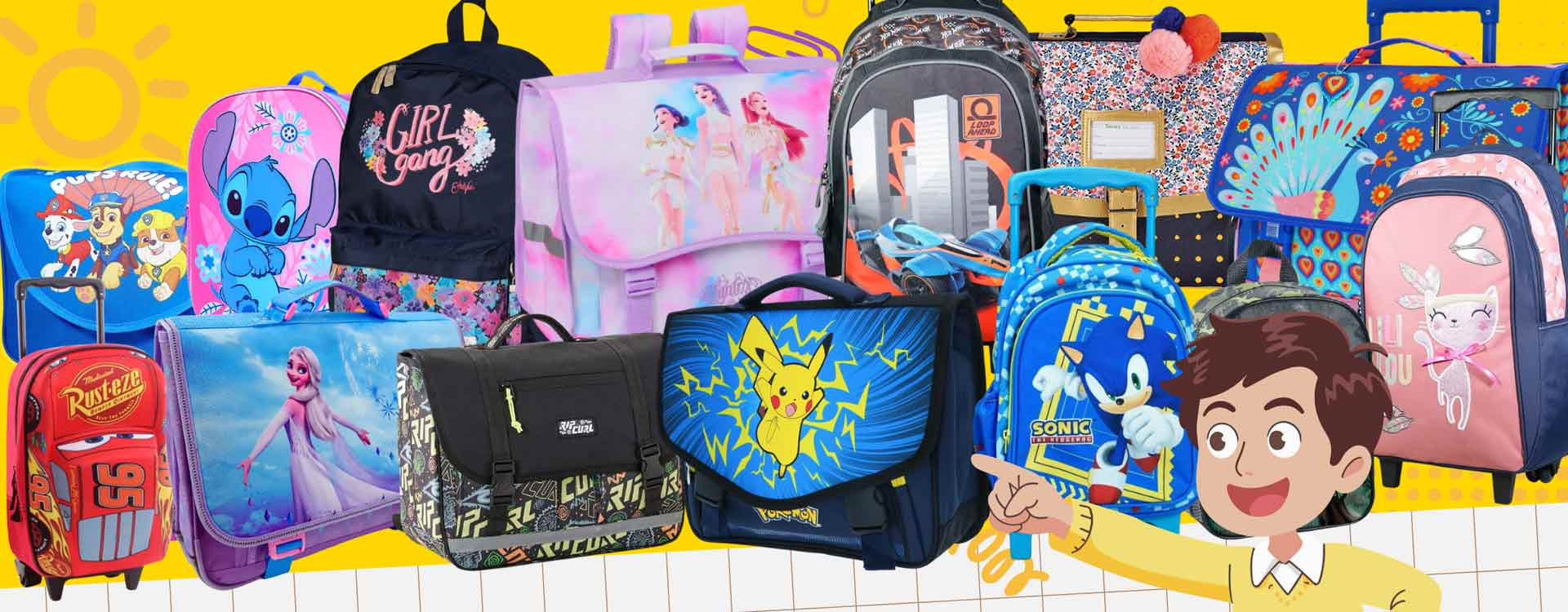
Which schoolbag to choose according to age and class? The ultimate guide
Choosing the right schoolbag for your child: what you really need to understand before buying
Choosing a schoolbag is an important step in a child's education. This choice is not limited to a question of taste, color or budget: it directly affects comfort, posture, autonomy and daily well-being.
It's precisely for this reason that many parents ask themselves which schoolbag to choose according to age and class, but without always finding clear, reliable answers.
Between kindergarten, primary school and the start of secondary school, needs change rapidly. The volume of equipment, the organization of classes, the child's morphology, his or her journeys and level of autonomy all play a decisive role. A schoolbag suitable for a first-grader won't necessarily be right for a second-grader, just as a bag chosen solely on the basis of age may prove ill-suited to the realities of the field.
This guide has been designed to help you make an informed choice, taking into account the class attended, the child's age, but also his or her actual daily life. The aim is not to propose a single rule, but to give you concrete guidelines for understanding what really makes a suitable schoolbag.
A guide designed to answer parents' real questions
✋Which schoolbag to choose for a 6-year-old?
✋Should I use a backpack or a hard schoolbag in primary school?
✋What size and weight are required for each class?
✋When should I change my schoolbag?
✋Is it reasonable to look ahead to the following year?
All parents ask themselves these questions at one time or another. Yet the answers are often contradictory, too general or disconnected from the day-to-day reality of families.
This guide has been designed to answer these questions in a simple, structured and reassuring way, based on concrete situations: class changes, school constraints, children's morphology, school organization and lifestyle habits.
A complete article, to be read according to your needs
This article is deliberately comprehensive. It can be read from beginning to end for a global view, or consulted by section according to your current priorities:
choosing the right size, understanding the recommended weight, comparing school bags, avoiding common mistakes, adapting a schoolbag to a particular situation or knowing when to replace it.
Each section has been designed to be self-contained, so that you can quickly find a clear answer, without having to go through the whole guide if you don't need to.
Caring support, close to families' daily lives
There's no question here of judging choices or imposing an ideal model. Every child is different, every family has its constraints, and every school operates in its own way.
The approach of this guide is deliberately benevolent and pragmatic. It is based on a simple idea: the right schoolbag is the one that adapts to the child's age, class and daily routine, not the other way around.
By taking the time to understand these elements, you'll be able to make a calmer, more lasting choice, and above all, one that's more respectful of your child's needs.
How to recognize a good schoolbag? 5 essential points to check
At first glance, many school bags look the same. The same format, the same promises of lightness, the same attractive designs. But not all of them meet the demands of everyday school life.
✅A good schoolbag isn't chosen for its looks or price alone. It must withstand intensive use, remain comfortable when loaded and make it easier for your child to organize day after day.
To make the right choice, there are a number of criteria that deserve special attention.
1. Sturdiness and durability: withstanding the rigors of the school year
A schoolbag is used several times a day, placed on the floor, pulled, sometimes overloaded, exposed to humidity or shocks. These conditions quickly reveal poorly designed models.
Visit seams are a reliable first indicator. They should be even, thick and reinforced at points of tension: straps, handles, bottom corners. These are the areas that give way first on entry-level satchels.
Visit bottom of schoolbag is just as important. A reinforced base keeps the bag stable, protects the notebooks and limits wear and tear when placed on the floor. Conversely, a base that's too soft will quickly sag, resulting in poor weight distribution.
✨ A well-designed schoolbag is designed to last a full school year, not just the first few weeks.
2. Ergonomics and carrying comfort: protecting your child's back and shoulders
Comfort is often relegated to second place at the time of purchase, even though it plays a central role in a child's well-being.
A comfortable schoolbag must remain pleasant when filled, and not just when empty. Suspenders should be wide, adjustable and padded to spread the load over the shoulders and avoid pressure points. Straps that are too thin or rigid quickly become uncomfortable as the weight increases.
Visit back panel, the padding, ideally quilted, enhances comfort and reduces chafing. It also helps keep the binder close to the back, preventing it from pulling back.
On some models, a chest strap is a real benefit, especially for children who walk for long distances or who tend to carry their bags askew. It improves stability and load distribution.
Posture professionals regularly point out that it's not just the weight carried that poses a problem, but above all the way it is distributed and worn on a daily basis.
✨ An ergonomic schoolbag must remain comfortable in real-life conditions, all day long.
3. Materials and rain protection: effective protection for contents
A school bag can be solid and comfortable, but quickly become problematic if its contents are not properly protected. Wrinkled notebooks, damaged books, damp pencil cases... These inconveniences are often due to unsuitable materials.
Visit outer fabrics must be sufficiently resistant and treated to limit water penetration. A water-repellent material is ideal for coping with everyday rain and bags placed on damp ground, without damaging school equipment.
Visit closures also play a key role. Poor-quality zips let moisture in easily and wear out quickly. Sturdy, well-stitched fasteners that are easy for the child to handle guarantee better protection over time.
Finally, some models feature an integrated waterproof inner lining, it's a discreet detail that makes a real difference in everyday life. It's an unobtrusive detail that makes a real difference in everyday life.
✨ A good schoolbag protects the contents as effectively as it transports the material.
4. Interior organization: facilitating storage and student autonomy
Interior organization is often overlooked when buying a child's home, even though it has a direct influence on the child's comfort and independence.
A well-organized binder several separate compartments. This separates notebooks from books, prevents everything from piling up in one place, and distributes weight more evenly. Clear organization also limits forgetting and endless searching in class.
Visit adapted pockets small accessories (pencil case, ruler, snack) help children to structure their belongings and quickly find what they need. On the other hand, an overly simple interior often leads to overloading a single compartment, which makes carrying unbalanced.
The aim is not to have a complex bag, but a space designed for the child's real everyday school life.
✨ Good interior organization promotes comfort, autonomy and concentration in the classroom.
5. Safety and visibility: better signage for children on their way to and from school
Safety is a discreet but essential criterion, especially for journeys on foot or by bike.
Visit Reflective elements integrated into the schoolbag improve visibility in low-light conditions, particularly in winter or on overcast days. Reflective strips, piping or logos make it easier for motorists to spot your child on the way to school.
Some models also reinforce the portage stability, a securely-fitting schoolbag reduces the risk of excessive movement when the child is running or walking for long periods. A schoolbag that stays securely in place reduces the risk of imbalance and improves overall safety.
These details may seem secondary, but they play a full part in making daily use more worry-free.
✨ A good schoolbag isn't just practical: it also contributes to your child's safety on the move.
What size schoolbag to choose? The most common mistake parents make
Choosing the right size schoolbag is one of the most delicate steps for parents. Too small, and it quickly becomes impractical. Too large, and the child feels uncomfortable, unbalanced and unnecessarily tired.
The most common mistake is to rely solely on age or to anticipate too much "to make your schoolbag last longer". In reality, size should be adapted to the child's morphology and actual school use.
Why is schoolbag size so important??
A poorly sized satchel has a direct impact on carrying comfort. If it's too big, it protrudes over the child's back, bumps against the legs and pulls backwards. If it's too small, it forces the closures to be forced and the equipment to be piled up, unbalancing the load.
The right size allows the binder to :
✅ stay flat against your back;
✅ distribute weight evenly;
✅ accompany movements without hindering the child.
✨ Size is more than just an aesthetic detail: it also determines the day-to-day use of the schoolbag.
Simple guidelines to avoid mistakes?
There are simple visual cues to check if the size is right.
A well-proportioned schoolbag:
✅does not extend beyond the shoulders;
✅reaches the kidneys;
✅is no wider than the child's back.
These markers enable you to quickly eliminate unsuitable models, even if you don't know the exact dimensions in centimetres.
✨Tip: if the binder looks too big when empty, it will be even bigger when full.
✋To find out more about precise dimensions and common errors, please consult our detailed guide to ideal schoolbag size.
Why age is not enough to choose the right size?
Two children of the same age can have very different body shapes. Relying solely on age can often lead to the wrong choice.
The ideal size depends more on :
➡️stature;
➡️shoulder width;
➡️back length;
➡️of the volume of material transported each day.
This is why a schoolbag suitable for a 7-year-old may be totally unsuitable for a child of the same age.
✨ Age gives an indication, but should never be the sole criterion for a decision.
Is it really necessary to choose bigger?to make it last"?
Looking ahead to the following year is a frequent temptation, but rarely a beneficial one. A schoolbag that's too big from the start is harder to carry, less stable and often less comfortable.
In practice, an unsuitable schoolbag:
❌makes the child more tired;
❌encourages poor posture;
❌sometimes discourages autonomy.
It's better choose a model suitable for the current year, we'll even replace it at a later date, rather than forcing the child to carry around an ill-sized schoolbag for several months.
✨ A schoolbag that "lasts" must first be adapted, not oversized.
How to refine your choice according to your child's build and school equipment?
Build plays a key role in size selection. A slim or small child will quickly become uncomfortable with an oversized schoolbag, even if it is theoretically suitable for his or her class.
It is also important to consider :
➡️the number of notebooks and books transported daily;
➡️the presence of a large-format binder;
➡️specific equipment requested by the school.
Observing the actual contents of the binder often makes for a more pertinent choice than relying solely on general recommendations.
✨ The best guarantee of long-lasting comfort is to adapt the size to your actual size and needs.
To remember
The size of the schoolbag is not a detail.
This is a central criterion that directly influences the child's comfort, balance and well-being throughout the school year.
✨ A well-sized bag is often the first step towards more comfortable carrying and better organization on a daily basis.
Weight, dimensions and capacity: real benchmarks for your schoolbag
Once the right size has been identified, three parameters must be analyzed together: weight, dimensions and actual capacity. Taken separately, they provide useful information. Taken together, they determine whether the schoolbag will really be suitable for the child's daily life.
Maximum weight according to age and class?
Healthcare professionals agree on a simple benchmark: the weight of a loaded schoolbag should ideally not exceed approximately 10% of the child's body weight, to limit strain on the back and shoulders, particularly in the case of young people.
This benchmark provides a basis for reflection, often relayed by healthcare organizations, but it should not be rigidly applied.For example, the French health insurance system reminds us in its prevention recommendations for children's backsThe weight of the schoolbag must remain reasonable and adapted to the student's morphology.
As a guide, this generally corresponds to :
➡️around 2 to 3 kg at the beginning of primary school;
➡️3 to 4 kg for a taller pupil;
➡️more at college, with reinforced vigilance.
However, this recommendation must be qualified. Two children of the same age may present :
➡️a different morphology;
➡️different muscle strength;
➡️very different daily routes.
It is also essential to distinguish between the empty weight of the schoolbag and the actual weight whefilled. A model that is very light when empty can quickly become problematic if it encourages overloading, due to a lack of structure or interior organization.
✨ The correct approach is to look at the total weight worn on a daily basis, not just the figure on the label.
Dimensions to suit the child's morphology?
.png)
The dimensions of the binder have a direct influence on posture. A model that's too big may seem practical, but it's rarely adapted to the child's size.
A few simple visual cues will help you avoid mistakes:
✅ width must not exceed that of the back;
✅ height must not exceed shoulders;
✅ the base should not extend too far down the back.
A disproportionate schoolbag can :
❌ pull back;
❌ unbalance posture;
❌ tire the child more quickly.
This doesn't mean that a slightly higher model is always problematic. It all depends on your body type, strap adjustment and the load you're carrying.
✨ The most important thing is that the schoolbag stays snug against the back, without excessive tossing, and that the child can carry it without arching or leaning forward.
Which capacity to choose according to actual school equipment?
Capacity, often expressed in liters, only makes sense if it's linked to the reality of the classroom.
In practice, the volume required depends on :
➡️notebook format (often 24 × 32 in primary schools);
➡️the presence or absence of filing cabinets;
➡️the number of books transported each day;
➡️school organization (locker or not).
A binder that's too small means you have to force the fasteners, which accelerates wear and tear on your equipment. Conversely, too large a volume often encourages you to carry more than you need, needlessly increasing your load.
✨ The right compromise is just the right amount of capacity, allowing you to store your equipment without constraint, while limiting the temptation to overload.
This is also where interior organization plays a decisive role: a well-compartmentalized schoolbag can offer more useful capacity than a larger but poorly designed model.
Lighter doesn't always mean better
The search for the lightest possible schoolbag can be misleading. A model that is very light when empty may seem ideal, but if it lacks structure, it can :
❌ poor weight distribution;
❌ sag when loaded;
❌ become uncomfortable with use.
Conversely, a satchel that's slightly heavier when empty, but well-structured and well-organized, can offer far greater comfort over time.
✨ The right criterion is therefore not absolute lightness, but the balance between weight, fit and real comfort.
To remember
To preserve the child's comfort and back, it is essential to find the right balance between :
➡️a reasonable overall weight;
➡️dimensions adapted to body shape;
➡️a capacity consistent with the material actually transported.
It's not a question of following numbers to the letter, but of making a choice that's adapted to the child, his class and his daily life.
Schoolbag or backpack: making the right choice?
Schoolbags and backpacks don't serve exactly the same purpose. While they both fulfil the same function, their design influences the way children transport, organize and carry their equipment on a daily basis.
The binder, generally more structured, offers good support and clear interior organization. It effectively protects notebooks and books, limits crushing of contents and encourages a certain rigor in tidying up. This structure is often reassuring for primary school pupils, especially when they are new to the demands of school.
The backpack, more flexible, provides greater support for movement. It adapts more easily to growth and to variations in content from one day to the next. It often becomes relevant as children become more independent, carry more variable equipment or move around more during the day.
▶️ To discover models adapted to different classes and morphologies, browse our selection of models school backpacks, designed to combine comfort and organization.
✨ The right choice therefore depends less on the "theoretical" age than on the level of autonomy, the quantity of material transported and actual carrying conditions.
Backpack or wheeled bag: beware of preconceived ideas!
The wheeled bag is often presented as a the ideal solution for back relief. In certain situations, it can indeed provide appreciable comfort, but it is not suitable for all contexts.
When used on long, mostly flat, unobstructed routes, it avoids having to carry the child on the shoulders. It can thus provide occasional relief for heavily laden children.
However, this solution quickly shows its limitations as soon as the route becomes more complex. Stairs, sidewalks, kerbs or uneven paths frequently force the child to carry the bag in spite of everything. A wheeled bag is often heavier unladen than a classic model.
✨ A wheeled bag makes sense when the journey really lends itself to it. Otherwise, it can become restrictive and sometimes counter-productive.
✋For a more in-depth analysis of the advantages and limitations of this type of model, see our folder dedicated to wheeled binders.
Rigid or flexible: understanding the real differences
The choice between a rigid and a flexible structure has a direct influence on user comfort and equipment protection.
A rigid model holds its shape better, protects large-format notebooks effectively and facilitates interior organization. It is often more stable when loaded, which limits imbalance. This structure is well suited to bulky or fragile equipment.
Flexible models offer greater flexibility. They adapt more easily to variations in content and are generally lighter when empty. They can be used when the load is moderate and the child knows how to organize his belongings.
✨ It's not a question of one type being "better" than another, but of choosing a structure that's consistent with the actual use of the school bag.
Things to remember before making a decision
Before making a decision, it's useful to ask yourself a few simple questions directly related to your child's daily life:
➡️how long he carries his bag each day?
➡️does the route involve stairs or difficult areas??
➡️is the equipment transported heavy and bulky??
➡️is the child autonomous in organizing his or her affairs??
The answers to these questions naturally point to the most appropriate solution.
✨ The right choice is not the one that seems most practical in theory, but the one that integrates seamlessly into everyday reality of the child.
- To give you a clearer idea of the differences, here's a brief comparison of the main types of school bags.
Comparative table of use of different types of school bags
School bag type | Observed benefits | Limits to take into account | Recommended use |
Structured binder (width > height) | - Effective protection for large-format notebooks (24x32) | - More rigid and therefore less flexible | Elementary school (CP to CM2) |
Structured school backpack | - Weight distribution on both shoulders | - Notebook protection varies according to structure | Late elementary and middle school |
Trolley bag | - Limits shoulder carrying | - Heavier when empty (frame + wheels + handle) | Long, mostly flat routes |
Soft backpack (lightweight model) | - Very light when empty | - Limited protection for notebooks | Kindergarten |
The type of bag is the first step.
It's just a question of deciding which one is right for your child's age and class.
Here's a clear guide to the link between grade level and recommended format.
Which schoolbag to choose according to age and class?
School needs evolve progressively over the course of a child's education. The volume of material, the level of autonomy expected and the constraints of daily life are not the same in kindergarten, primary school or at the start of secondary school.
Age and class are therefore useful benchmarks, as they give an initial indication of :
➡️the quantity of material to be transported;
➡️the type of organization required;
➡️comfort and strength.
But these benchmarks must always be qualified. At the same age, morphologies differ, as do the way schools operate and transport habits.
✨ The advice that follows provides a clear framework, which can then be adapted to each child's specific situation.
Kindergarten: lightness, simplicity and autonomy above all else
In kindergarten, the bag is not designed to carry heavy books or notebooks. It's mainly used to hold a few personal items: a cuddly toy, a diaper, a snack or a small notebook.
The priority is therefore lightness.
A model that is too big or too rigid is of no benefit at this age, and may even hinder the child's movements.
Preference is given to :
✅ a compact format;
✅ very low weight;
✅ easy-to-handle opening;
✅ simple, adjustable straps.
Backpacks are generally more suitable than traditional satchels, as they provide better support for movement and enable children to carry their bags alone over short distances.
✨ The aim is not to anticipate further schooling, but to encourage autonomy without constraint.
CP: the first real school bag, a key stage
The start of first grade marks an important turning point. From now on, the bag must hold large notebooks, sometimes a folder and a few books.
The challenge is to find a model:
➡️sufficiently spacious (but not oversized);
➡️well-organized;
➡️comfortable when charged.
This is also the time when mistakes are common: choosing too large "to make it last"or too heavy"because it looks solid".
In CP, it is preferable to focus on :
✅a size compatible with 24 × 32 notebooks;
✅a structure to help organize;
✅good back and shoulder support.
✨ A structured binder may be appropriate at this stage, provided it remains proportionate to the child's morphology.
▶️ If you're looking for a model suited to primary school requirements, take a look at our selection of binders for elementary school, designed to accommodate large-format notebooks and accompany the child on a daily basis.
CE1 - CE2: more equipment, more requirements
In CE1 and CE2, the volume of material gradually increases. Pupils carry more notebooks, sometimes a binder and more textbooks.
The bag must then offer :
✅slightly higher capacity than CP;
✅efficient interior organization;
✅solidity that lasts.
It's also a time when children are gaining in autonomy. They begin to manage their belongings on their own, sometimes overloading their bags unnecessarily.
✨ Carrying comfort then becomes central: well-adjusted shoulder straps, comfortable back and good distribution of contents.
Depending on the child's daily routine, a structured schoolbag or a well-designed backpack can both be suitable.
CM1 - CM2: greater autonomy and transition to middle school
At the end of primary school, needs evolve further. The material is more substantial, the days sometimes longer, and the organization gradually approaches that of middle school.
At this stage, several factors come into play:
➡️the child's ability to manage his bag alone;
➡️the actual load transported each day;
➡️moving around the school.
Many families then turn to a school backpack, considered more versatile. This may be a wise choice, provided that the model remains :
✅sufficiently structured;
✅adapted to body shape;
✅comfortable over time.
✨ The mistake would be to switch too early to an unsuitable model just because "college is coming". Immediate comfort must always come first.
6th grade: new rhythms, new constraints
Starting sixth grade has a profound effect on daily life. Students take several subjects a day, move around the school more and don't always have access to a locker.
The bag becomes a real everyday tool, worn longer and more often. In most cases, the backpack is a practical solution, because it :
✅better weight distribution;
✅frees up movement;
✅adapts to variable volumes.
However, not all models are created equal. A school bag must be comfortable, well-organized and robust enough to withstand repeated loads.
✨ Even at this age, the choice should never be made at the expense of comfort and health.
✋For students entering middle school, find our tips for choosing a backpack adapted to the demands of high school.
To remember
Choosing a binder - or more broadly, a school bag - according to age and class helps to establish a coherent framework. But this framework must always be adjusted:
➡️The child's morphology;
➡️To its everyday reality;
➡️to the specific constraints of its school.
✨ The right choice is the one that accompanies the child where it is today, without weighing it down unnecessarily, either physically or mentally.
However, even with an age- and class-appropriate bag, some special situations merit going beyond the standard.
Summary table: the ideal school bag by age and class
After detailing the needs at each stage of schooling, this table enables you to take stock in the blink of an eye.
It doesn't replace previous explanations, but summarizes them to help parents quickly check whether they're heading in the right direction.
The aim is not to lay down strict rules, but to propose a range of reliable benchmarks, they're easy to understand and adapt to the school's morphology, day-to-day life and operations.
To help you quickly visualize which schoolbag to choose according to age and class, here's a clear summary of the widths and volumes generally proposed by manufacturers for structured schoolbags (format wider than high)..png)
This table is particularly useful:
✔️when comparing different models;
✔️to validate a choice before purchasing;
✔️or to quickly identify an inconsistency (bag too big, too heavy, ill-fitting).
How to read this table?
♦Class / AgeThe main point of reference
♦Recommended bag typeThe best solution in most cases
♦Indicative size/capacityOrder of magnitude, not an absolute rule
♦Load marker Essential supplies to carry
♦Priorities to be checkedComfort benchmark, to be adjusted according to the child's needs
♦Vigilance / To avoidKey criteria not to be overlooked
Summary table - School bag by age and class
This table summarizes the most common formats and volumes by age and class.
Class/Age | Recommended bag type | Format / mark (cm) | Observed volume (L) | What it should enable (concrete benchmarks) | Priorities to be checked | Vigilance / To avoid |
Kindergarten | Small lightweight bag / satchel | 32 cm | ~10 L | Soft toy + diaper change + small liaison notebook / snack | Lightweight, easy opening, autonomy | Too large or too rigid (discomfort and loss of autonomy) |
CP → CE2 | Structured binder or reinforced backpack | 38 cm | ~17-18 L | Cahiers 24×32 + kit + snack | Interior organization, back support | Oversized "to last" (overload-friendly) |
CE2 → CM2 | Well-compartmented binder/ structured bag | 41 cm | ~23 L | Notebooks + textbooks + sometimes binders | Carrying comfort, sturdiness, adjustments | Model too flexible for heavy manuals |
6th → 5th | Sturdy school backpack | 41 cm | ~24-26 L | Textbooks + notebooks + pencil case + bottle / meal depending on day | Weight distribution, autonomy, durability | Too small or without back support |
4th → 3rd | School backpack + good fit | 41 cm | ~26-30 L | Textbooks + notebooks + personal materials + extras | Long-lasting comfort, organization, sturdiness | Unorganized bag (clutter, uneven weight distribution) |
The volumes and sizes given above are taken from the benchmarks of reputable manufacturers and retailers (Tann's), Eastpak, , Kipling, , Kickers) and correspond to models actually on the market for each age group. These benchmarks must then be adjusted according to the child's morphology, the daily route, the presence or absence of lockers, and the actual volume of equipment required by the school.
Things to remember
➡️Benchmarks gradually evolve, not suddenly from one class to the next.
➡️The type of bag depends as much on autonomy as on age.
➡️Morphology and daily commutes may require adjustments.
➡️A "theoretically suitable" bag can become uncomfortable if incorrectly set or overloaded.
✨ This table is used to direct, not to impose.
The right choice is always the one that matches the the child's daily life.
Compare the different types of school bags: advantages, limitations and uses
When it comes to choosing a school bag, parents are often faced with clear-cut oppositions: hard or soft, well-known brand or more affordable model, licensed bag or more sober design.
These comparisons can be useful... as long as they are placed in the child's real-life context. One type of bag is neither good nor bad in itselfIt becomes relevant - or not - depending on use, frequency of wear and level of autonomy.
The aim of this section is not, therefore, to designate a "best bag"but to help understanding concrete differences to make a coherent, sustainable choice.
Rigid or flexible structure: two approaches, two uses
Rigid-structure bags are often favored in primary schools for their strength and stability. They enable :
✅effectively protect notebooks and books;
✅maintain a stable shape, even when loaded;
✅easy storage thanks to a clearer organization.
They are particularly suitable for carrying large-format notebooks, several textbooks or materials that need to lie flat.
The softer models, on the other hand, focus on flexibility. They adapt better to variations in content and are easier to move with. Their lightness can be appreciated when the load remains moderate and the child knows how to organize his bag without piling everything up.
✨ The right choice therefore depends as much on type of material transported than child's ability to manage day-to-day organization.
Premium brands or more affordable models: what do you really pay??
Faced with price differences that are sometimes substantial, it's legitimate to wonder about the real value of a more expensive bag.
Models positioned aspremium"generally suggest :
➡️more resistant materials;
➡️enhanced ergonomics;
➡️meticulous finishes;
➡️sometimes better durability.
These features can be a real advantage when the bag is used intensively or over several years.
On the other hand, some more affordable models offer an excellent compromise when well-designed and adapted to a specific use. In these cases, paying more does not necessarily bring additional concrete benefits for the child.
✨ The price must therefore be analyzed in terms of actual use, and not as an automatic guarantee of quality.
Licensed patterns or plain design: a choice with more impact than you might think
Bags bearing the effigy of well-known characters or licenses are often very appealing to children, especially the younger ones. This attachment can reinforce the desire to wear and respect your bag.
However, this type of choice deserves careful consideration. Tastes sometimes evolve rapidly, and a very distinctive design can become boring before the end of the school year. Sometimes, too, the price has more to do with licensing than manufacturing quality.
Plain or more soberly patterned models generally offer :
➡️longer-lasting aesthetics;
➡️ease of transmission or resale;
➡️a certain timelessness.
✨ The right compromise is often between the child's desire and a medium-term vision bag.
New or second-hand bag: an option worth considering?
A second-hand school bag can be a interesting alternative, particularly for budgetary and ecological reasons. However, this option requires particular vigilance.
Before making a decision, it is essential to check :
➡️condition of straps and seams;
➡️the solidity of the bottom;
➡️comfort when worn;
➡️general hygiene.
A well-worn bag, even at a low price, may quickly become uncomfortable or unsuitable. On the other hand, a model in excellent condition may be perfectly suitable if it remains proportionate to the child's morphology and needs.
✨ Opportunity makes sense when it doesn't compromise comfort or durability.
To remember
These comparisons highlight a key point:
there is no universal choice, these are just choices more or less adapted to a given situation.
Before making a decision, it's always a good idea to ask yourself:
➡️how the bag will be used on a daily basis;
➡️how long it will be worn each day;
➡️what the real constraints of school and commuting are.
✨ The best choice is not the one that ticks all the boxes "on paper", but the one that integrates naturally into the child's daily routine.
Even after these comparisons, certain criteria remain highly personal and outside the norm: morphology, particular routes, family organization..
Adapting the schoolbag to your child's real-life situation
Age and class guidelines are a solid basis, but they don't cover every situation. In reality, each child has his or her own daily routine, morphology, routes, constraints and family organization.
Adapting the binder to the child's real-life situation allows us to go beyond standards and avoid choices which, on paper, seem coherent... but which turn out to be uncomfortable or unsuitable for use.
Atypical morphology: adapting when the child is shorter or taller than average
Two children of the same age may differ significantly in height and build. In these situations, relying solely on class or age can lead to an inappropriate choice.
For a smaller-than-average child, an overly bulky satchel can unbalance the posture, pulling the child backwards and limiting freedom of movement. Conversely, a taller or more robust child may be able to carry a slightly more structured model, provided the weight remains reasonable and well distributed.
✨ The most reliable benchmark is the proportion between bag and back, this is far more important than "CP", "CE1" or "CM1".
Long distances on foot: reduce fatigue and stress
When the home-to-school journey is mostly made on foot, carrying comfort becomes a central criterion.
In this context, it is preferable to :
✅an ergonomic bag;
✅wide, well-padded shoulder straps;
✅good stability when worn.
An ill-fitting or overly rigid model can quickly become uncomfortable over time, even if it looks right on paper.
✨ For longer journeys, the comfort on the move must always take precedence over aesthetics or maximum capacity.
Back or shoulder pain: adjusting choice and settings
A child who regularly complains about his back, shoulders or neck sends out a signal that should not be ignored.
Before changing models immediately, it's a good idea to check :
➡️strap adjustment;
➡️the height of the bag on the back;
➡️content distribution;
➡️the weight actually transported each day.
In some cases, a well-adjusted and better-organized bag is enough to improve the situation. In other cases, the chosen model is simply not (or no longer) suited to your morphology or use.
✋To find out more, discover our complete tips for Avoid schoolbag-related backache.
✨ If pain persists despite correct adjustments and a reasonable load, the advice of a healthcare professional may be useful to rule out any specific cause.
School with or without locker: a direct impact on weight carried
The presence or absence of a criminal record influences the quantity of supplies transported each day.
Without a locker, children generally carry all their notebooks, textbooks and sometimes special equipment. The bag must therefore offer sufficient capacity while remaining comfortable.
Conversely, when a locker is available, the daily volume can be reduced. This makes it possible to choose a more compact, lighter model, without sacrificing organization.
✨ Adapting the bag to the school's needs often considerably reduces the amount of weight carried.
Lots of school equipment: plan ahead for organization and capacity
Some students have to carry more material than others, especially in double-level classes or in schools using a variety of teaching aids.
In these situations, the inner organization of the bag becomes decisive. A well-compartmented model distributes weight more evenly, avoids untidy stacking and makes it easier to find your things in class.
✨ A larger volume can be justified, provided that it is really useful and intelligently organized.
After-school activities: managing the transport of additional materials
When children combine school with sports or cultural activities, the question of the bag arises in a different way.
There are several possible solutions:
➡️use a separate school bag and sports bag;
➡️leave activity equipment on site whenever possible;
➡️Avoid loading the school bag with unnecessary items all day long.
✨ The objective is simple: don't turn the satchel into a bag"Tote bag", at the expense of comfort.
Alternating custody: thinking of the bag as an organizational tool
In the case of alternating custody, schooling must be adapted to the child's needs to a particular organization. Some families opt for a bag in each home, while others opt for a single schoolbag, perfectly organized and regularly emptied.
In this context, sturdiness, capacity and ease of storage take on particular importance in order to limit forgetfulness and unnecessary transportation.
✨ A well-thought-out bag and clear organization are often more effective than a larger model.
To remember
These situations show that there is no one-size-fits-all solution choices adapted to different realities.
Taking into account the child's actual daily life allows :
➡️avoid classic mistakes;
➡️improve comfort;
➡️to make a more relevant and sustainable choice.
But even with the right bag, certain preconceived ideas continue to influence parents' decisions..
5 preconceived ideas about the schoolbag... to be avoided at all costs!
When it comes to choosing a schoolbag, certain ideas come up time and time again. They circulate between parents, are sometimes relayed online and end up becoming obvious.
The problem is not that they are totally false, but that they are often applied without nuance. But when it comes to choosing a school bag, shortcuts often lead to inappropriate decisions.
The aim of this section is therefore simple: take a step back and explain when these ideas may be relevant, and especially when they become misleading.
1. The lighter the binder, the better
Lightness is an important criterion, but it should never be analyzed in isolation.
A lightweight schoolbag may seem ideal at first glance. However, if it lacks structure or support, it can distribute weight poorly once loaded, sagging against the back and becoming uncomfortable over time.
Conversely, a well-designed model that is slightly heavier when empty can offer greater stability, more even load distribution and superior comfort in real-life conditions.
✨ The correct benchmark is not the weight shown on the label, but real comfort once the schoolbag has been filled and carried.
2. Same age, same school bag
It's one of the most common misconceptions... and one of the most misleading!
Two children of the same age may differ significantly in morphology, muscle strength or daily routine. Relying solely on age or class can lead to inappropriate choices, this is especially true for smaller-than-average children, those who walk a long way or those who carry more equipment.
Age provides a general framework, but does not take into account :
➡️of the actual template;
➡️daily commutes;
➡️school organization.
✨ Age is a starting point, not a sufficient decision criterion.
3. Girl or boy: a simple question of color
Reducing the choice of a schoolbag to a question of color or pattern is an oversimplification.
Of course, the child's tastes count. A bag that pleases will be more easily worn and respected. But gender says nothing about comfort, morphology or real needs.
Choosing the right schoolbag depends above all on :
➡️template;
➡️carrying comfort;
➡️organizational skills;
➡️level of autonomy.
✨ A good schoolbag isn't "for girls" or "for boys": it's for girls and boys tailored to a specific child, with its own specific needs.
4. The more expensive, the better the quality
Price is often perceived as a reliable quality indicator. In some cases, this logic is true...but it is not far from systematic.
A higher price may correspond to better materials, more advanced ergonomics or more meticulous finishing. These elements make sense when the bag is used intensively or over a long period of time.
However, some more affordable models offer excellent value for money when well designed and adapted to a specific use. Conversely, an expensive bag that is poorly adapted to the child's needs may prove uncomfortable and of little use.
✨ The right criterion is not price, but the suitability of the bag for actual use.
5. One model fits all
This idea often comes up when a schoolbag is very popular or recommended by friends and family. However, there is no universal model.
Each child has :
➡️its size;
➡️its rhythm;
➡️school constraints ;
➡️its level of autonomy.
What's perfect for one child may be totally unsuitable for another, even in the same class and the same school.
✨ The right choice is never the one that "everyone else makes", but the one that "everyone else makes" really corresponds to the child's situation.
To remember
Conventional wisdom often has a basis in truth, but it becomes problematic when applied without thought.
To make the right choice, it is essential to :
✅overcoming automatisms;
✅observe the child's daily life; ;
✅focus on comfort and adaptation over time.
✨ The best choice is always based on context, never a single rule.
Once these preconceived ideas have been deconstructed, there's one more important step:
identify most frequent errors what parents do at the time of purchase.
The most common mistakes when buying a schoolbag
Even with the best of intentions, it's easy to make a mistake when choosing a schoolbag. The majority of mistakes are not due to carelessness, but to false good ideas, it's all a question of the best advice, of advice that's too general, or of decisions that are taken a little too quickly.
Identifying these pitfalls can help you avoid inappropriate purchases and, above all, improve your students' comfort and everyday life.
Buy too big "to make it last longer"
This is the most common mistake.
Many parents deliberately choose a larger schoolbag, thinking that it will last for several years. In reality, this anticipation often backfires on the child.
An oversized model:
❌is heavier unladen;
❌encourages you to carry more than you need;
❌sometimes exceeds the width or height of the back;
❌unbalanced posture.
✨ Today, it's better to have the right schoolbag, it's better to wear a new pair, even if you have to change them later, than one that's too big and worn uncomfortably for months on end.
Neglecting the tare weight
When comparing models, empty weight is sometimes relegated to second place, especially if the schoolbag looks comfortable at first glance.
Yet a few hundred extra grams can make a real difference once the bag is loaded. A model that is already heavy when empty leaves less margin before reaching an excessive total weight.
✨ The right thing to do is to ask yourself a simple question:what margin is left after adding notebooks and books??
Choose by appearance or license only
The child's favorite colors, patterns and characters play an important role. They contribute to motivation and enjoyment of school.
But a choice based solely on aesthetics can lead to the neglect of essential elements:
➡️carrying comfort;
➡️ergonomics;
➡️interior organization;
➡️durability over time.
✨ The ideal is to find a balance: a model that appeals to children, without compromising on adaptation to their physical and academic needs.
Forgetting settings after purchase
Even the best schoolbag can become uncomfortable if it's badly adjusted. Many parents forget to adjust the shoulder straps correctly, check the height of the bag on their back or rebalance the contents as the year progresses.
Incorrect adjustment can :
❌increase fatigue;
❌cause pain;
❌give the impression that the binder is the wrong choice, when it isn't.
✨ Regular adjustment, particularly at the beginning of the year, at the start of each new school year and after the growing season, is essential.
Overloading the bag unnecessarily
Another common mistake is to let the child carry all his equipment every day, even when it's not necessary.
This often happens when :
➡️cases are not sorted;
➡️useless notebooks left in the bag;
➡️class organization is poorly understood.
✨ Teaching children to sort regularly is just as important as the choice of binder itself.
Ignoring the real needs of the class
Finally, some parents keep the same schoolbag without reassessing its suitability, whereas needs change significantly as classes progress.
A model perfectly adapted to CP can become :
➡️too small;
➡️poorly organized;
➡️insufficiently robust in CE2 or CM1.
✨ The choice of binder must be readjusted when school expectations and morphology change, not fixed once and for all.
To remember
Most mistakes can be avoided by asking yourself three simple questions.
1️⃣ Is it adapted to the child's current morphology?
2️⃣ Is it comfortable once the bag is loaded?
3️⃣ Is it consistent with real-life everyday school life?
✨ A good choice is not the one that seems practical at the time, but the one that accompanies the child without constraint over the months.
Even after these mistakes have been avoided, certain questions keep coming up for parents... sometimes without being spelled out.
Questions parents ask, but don't always formulate
When it comes to choosing a school bag, certain questions are not always clearly formulated. They may not be the subject of direct research, but they do cross the minds of many parents, sometimes at the time of purchase, sometimes a few weeks after the start of the school year.
Addressing them can remove doubts, provide reassurance and avoid decisions taken in a hurry or out of guilt.
Can my child keep the same school bag for two years??
This is a very frequent question, often linked to practical or budgetary considerations.
In some cases, yes, a school bag can accompany a child over two years. This depends on three main factors: the solidity of the model, the evolution of the volume of supplies and the growth of the child.
A bag chosen at the beginning of primary school can sometimes be suitable the following year if :
➡️it's not already at the limit in terms of capacity;
➡️the child's morphology has not changed much;
➡️comfort remains satisfactory once loaded.
✨ On the other hand, prolonging the use of a bag that has become too small, too heavy or uncomfortable is never a good idea. Comfort and well-being must always take precedence over length of use.
Should I change my bag during the year??
Changing bags during the year can feel like a bad initial choice. In reality, it's sometimes a simple adaptation to a changing situation.
This may be relevant in particular:
➡️if the child regularly complains about his back or shoulders;
➡️if the volume of material has risen sharply;
➡️if the bag is damaged or no longer fits properly.
✨ Changing bags during the year is not a failure, but a pragmatic decision. Better to adjust the solution than leave the child in discomfort for several months.
My child sometimes complains about his back, but not every day: should I be worried??
Occasional discomfort can occur, especially during busier-than-usual periods. They are not necessarily alarming in themselves.
On the other hand, repeated complaints, however minor, always deserve a minimum of attention. Before considering a bag change, it is a good idea to check :
✅settings;
✅content distribution;
✅the weight actually transported each day.
✨ If pain persists despite these adjustments, it's best to seek the advice of a healthcare professional to rule out any more specific causes.
Is it a problem if the bag extends a little beyond the shoulders??
This situation often worries parents, and rightly so.
A bag that extends slightly beyond the shoulders is not necessarily a problem if :
➡️well-tuned;
➡️it lies flat against the back;
➡️it does not pull excessively backwards;
➡️reasonable weight.
On the other hand, a schoolbag that is far too big or ill-fitting can unbalance posture and cause premature fatigue.
✨ The most reliable benchmark is the child's actual comfort when walking with the bag.
Do I need a different bag for sports or after-school activities??
When children combine school with sports or cultural activities, the question of double equipment naturally arises.
In most cases, it is it's best to keep one bag dedicated to school supplies and use a separate bag for sports or activities.
This limits overloading, preserves supplies and improves day-to-day organization.
✨ All-in-one" solutions may seem practical, but they often become cumbersome and impractical to use.
To remember
These questions show one essential thing:
the choice of a school bag is neither fixed nor definitive.
It evolves with :
➡️child growth;
➡️school requirements;
➡️everyday habits.
✨ Observing, adjusting and listening are often the right decisions.
When to replace your child's schoolbag?
Choosing a schoolbag doesn't stop the day you buy it. Over time, needs evolve, materials change and children grow. A model that's perfectly adapted at the beginning of the year may become less relevant a few months later, without this being immediately obvious.
Identifying the right time to replace the schoolbag avoids discomfort, unnecessary pain and decisions taken in a hurry.
Identify warning signs of wear and tear
A schoolbag is subject to intensive daily use. Certain signs of wear and tear should be taken seriously, even if the bag still looks "good"usable".
Among the items to watch out for:
➡️seams that are starting to give way;
➡️loose, frayed or poorly padded shoulder straps;
➡️closures that are difficult to open or close;
➡️a collapsed or deformed bottom;
➡️loss of support once the bag is worn.
✨ A worn-out schoolbag is not just an aesthetic problem. It can lose comfort, stability and the ability to distribute weight.
We also detail the situations in which it becomes necessary to change equipment in our article dedicated to when to replace your child's schoolbag.
When school needs change with the classroom
Even with no visible wear, a schoolbag can become unsuitable simply because school requirements are changing.
The transition from one class to another is often accompanied by :
➡️a larger volume of material;
➡️new notebook and binder formats;
➡️heavier manuals;
➡️a different kind of classroom organization.
A bag that's become too small or badly organized can force children to pile up their belongings, needlessly increasing the weight carried and complicating tidying up in the classroom.
✨ It is therefore appropriate to reassess the suitability of the binder At each class change, even if it's still in good condition.
Child growth: an often underestimated criterion
Morphology evolves rapidly, especially in primary school. A well-proportioned schoolbag at a given moment can become, a few months later :
➡️too small;
➡️badly positioned on the back;
➡️less comfortable to wear.
Certain signals should attract attention:
❌the bag sits too low on the back;
❌it no longer lies flat against the back;
❌settings are at their maximum without offering a good fit.
✨ When a schoolbag no longer keeps pace with your child's growth, it's often best to consider replacing it, even if it's not yet worn out.
Looking ahead to next year: a good idea or a false precaution??
Many parents hesitate between two approaches: buying a schoolbag strictly adapted to the current year, or slightly anticipating the following year.
A moderate anticipation can sometimes be relevant, especially when two school levels are close in terms of needs. A slightly evolving model can accompany a child over a short transition period.
On the other hand, anticipating too early often leads to :
❌a schoolbag that's too big;
❌an unnecessary burden;
❌prolonged discomfort.
✨ Anticipation is only beneficial if it does not penalize immediate comfort of the child.
Changing bags during the year: when is it appropriate??
Changing binders during the year may seem restrictive or excessive. But in some situations, it's the right thing to do.
This can be considered when :
➡️regular back or shoulder complaints;
➡️the bag has become clearly unsuited to his needs;
➡️wear compromises comfort or safety.
✨ Better to adjust the solution than leave the child in an uncomfortable situation until the end of the school year.
To remember
Replacing a schoolbag is neither a whim nor a failure. It is often a necessary adaptation to wear and tear, growth or changing school needs.
✨ The right time to change is when the schoolbag no longer adequately meets the child's needs, even if it's not completely worn out.
What's the right budget for a suitable, durable schoolbag??
When preparing for back-to-school, the question of the schoolbag budget comes up very quickly. Between the very affordable models and those at higher prices, it's not always easy to understand what really justifies the differences, or where to place the cursor.
The aim here is not to set a budget, but to ensure that our customers' needs are metideal"nor to rank families according to their means, but to provide concrete guidelines for fair investment, based on the child's real needs.
What really makes the price of a schoolbag vary
The price of a schoolbag can vary greatly from one model to another. Several factors come into play, but they don't all have the same impact on comfort and everyday use.
Among the elements that really influence the price are :
➡️the quality and durability of materials;
➡️the strength of seams and tension points;
➡️level of ergonomics (back, straps, support);
➡️interior design and organization.
Other factors play a greater role in commercial positioning:
➡️brand awareness;
➡️the presence of a well-known license or universe;
➡️design or stylistic effects.
✨ A higher price may correspond to a real gain in comfort or durability... but not systematically. The key is to understand what you actually pay.
Small budget: focus on the essentials without sacrificing comfort
With a limited budget, it's quite possible to find a suitable schoolbag, provided you make targeted choices.
In this range, it is particularly important to check :
➡️tare weight;
➡️seam strength;
➡️the comfort of straps;
➡️the right size for the class.
On the other hand, it is often preferable to compromise on :
➡️superfluous options;
➡️certain aesthetic details;
➡️accessories of little everyday use.
✨ A simple, well-proportioned and comfortable schoolbag will always be a better choice than a model that's visually appealing, but hard on the wallet.
To find out more about the reasons for price differences and where to draw the line, take a look at our detailed analysis of the price of a schoolbag.
Intermediate budget: the best compromise for most families
For many parents, the mid-range budget is the best way to spend their money Balance between comfort, sustainability and cost control.
Binders in this range generally feature :
✅enhanced ergonomics;
✅efficient interior organization;
✅more resistant materials;
✅satisfactory long-term comfort.
They are particularly suitable when :
➡️the child carries his bag for a long time;
➡️the volume of material is substantial;
➡️the schoolbag must last the whole year without loss of comfort.
✨ This is often the most "serene"because it avoids frustrating compromises without over-investment.
Higher budget: when spending more really makes sense
A larger budget may be justified in certain specific situations.
This is particularly the case when :
➡️the child carries a lot of material;
➡️long commutes;
➡️ergonomics is a top priority;
➡️the binder is designed to last more than a year.
In these conditions, the higher-end models can offer a better real plus in terms of support, weight distribution and durability.
✨ That said, a high budget is never a guarantee in itself. Even in this range, the schoolbag must remain child-friendly, and not chosen solely for its positioning.
Licensing, branding, design: what they bring... and their limits
Licensed or branded binders can be more expensive, without necessarily offering a proportional gain in comfort or sturdiness.
They can, however, play a positive role in :
✅the child's motivation;
✅the desire to carry your bag;
✅attachment to school equipment.
✨ The child's enjoyment is important, but it must remain one criterion among others. It's important to check that design is not at the expense of comfort, ergonomics or durability.
To remember
There is no such thing as a universal budget"ideal"for a school satchel.
The right budget is the one that allows you to choose a model:
✅adapted to the child's morphology;
✅comfortable for everyday use;
✅consistent with school constraints;
✅over the planned period.
✨ A well-chosen schoolbag, even if it's not the most expensive, is often the best long-term investment.
Practical checklists for making the right choice
With so many criteria to consider, it's easy to feel like you're forgetting something when buying or using a schoolbag.
These checklists have been designed as real memory aids Our products are easy to use, quick to consult and useful at different times of the year.
✨ They can be used prior to purchase, for initial adjustments, or during the year to take stock.
Pre-purchase checklist: adopt the right reflexes
Before choosing a schoolbag, take a few minutes to check the essentials:
- Is the size proportionate to the child's back?
- Is the empty weight reasonable for his age and build?
- Are the straps wide, adjustable and comfortable?
- Is the back sufficiently padded?
- Does the capacity correspond to the equipment actually used in the classroom?
- Does the interior layout distribute weight evenly?
- Is the model suitable for everyday journeys (walking, stairs, transport)?
- Does the design appeal to the child? without being the only criterion?
✨ If the majority of these points are validated, the binder is probably suitable for the situation.
Adjustment checklist: optimizing day-to-day comfort
Even a good schoolbag can become uncomfortable if it's badly adjusted. These simple checks make a real difference:
- Are the straps symmetrically adjusted?
- Does the bag lie flat against your back, without flapping?
- Isn't the base of the bag too low?
- Is the chest strap, if fitted, correctly positioned?
- Is the content evenly distributed between compartments?
✨ Settings should be reviewed regularly, especially at the beginning of the year and after periods of growth.
Organization checklist: limiting unnecessary weight
Comfort also depends on what the child carries each day. A few simple habits can help prevent overloading:
- Check the contents of the bag regularly.
- Remove unwanted notebooks and books.
- Place heavy objects as close to the back as possible.
- Use the compartments provided to organize supplies.
✨ Good organization often helps reduce weight without changing your satchel.
In-year checklist: knowing when to readjust
As the months go by, certain signals should prompt us to take stock:
- The child complains of pain or unusual fatigue.
- The bag is difficult to close or constantly too full.
- Adjustments are no longer enough to ensure comfort.
- School needs have evolved (new media, new volumes).
✨ These signals indicate that an adjustment is necessary, whether it's an adjustment, a reorganization... or a binder change.
To remember
These checklists are no substitute for daily observation, but they do help to secure decisions, quickly and stress-free.
✨ A good choice is as much about the binder itself as it is about the way it is set up, organized and used.
Schoolbags for girls or boys: what really counts
When it comes to choosing a schoolbag, many parents wonder whether they should opt for a "for girls"or "for boys". The market offer, highly segmented in terms of colors and graphic universes, often keeps this question alive.
However, the real question is not who the binder is intended for, but rather To which specific child it needs to adapt. And on this point, gender is rarely a relevant criterion.
Girls and boys: needs are not so different
Contrary to popular belief, schoolbag needs are largely the same for girls and boys, especially in primary school.
At the same age, the most marked differences are not related to gender, but to :
➡️size;
➡️build;
➡️posture;
➡️level of autonomy;
➡️the volume of material transported.
✨ An adapted schoolbag responds above all to physical and practical needs, not to a "girl" or "boy" category.
Morphology and comfort come first
The overriding criterion is always the same: adaptation to the child's body.
A good schoolbag is above all :
✅ proportionate to the back;
✅ comfortable when charged;
✅ correctly set;
✅ stable when worn.
These elements have nothing to do with gender. An uncomfortable bag doesn't become more suitable because it's pink, blue or decorated with a popular motif.
To find out more about the criteria that really define good school equipment, take a look at our guide to best schoolbag for a primary school pupil, in this issue, we detail the essential points to check before you buy.
✨Comfort and ergonomics must always take precedence over marketing codes.
Children's tastes: a real driving force in everyday life
While functional criteria are essential, the child's preferences also play an important role.
A binder he loves:
➡️will be worn with greater pleasure;
➡️encourage adherence to school routine;
➡️will reinforce the sense of ownership.
It's therefore perfectly legitimate to take into account your customers' tastes, favorite colors or the graphic universe that speaks to them.
✨ What's important is that these aesthetic choices come from in addition, and not as a replacement, for comfort and adaptation criteria.
Beware of stereotypical choices
Limiting a child to one choice "because it's for girls"or "because it's for boys"This can sometimes lead to unnecessary frustration.
Some children prefer :
➡️ sober designs;
➡️ neutral colors;
➡️ or, on the contrary, highly distinctive motifs, independent of traditional codes.
✨ Leaving room for freedom, this often leads to a more serene and better-accepted decision, within a framework defined by the parents.
Fast-changing tastes: it's best to anticipate
Tastes evolve rapidly, especially among the very young. A beloved motif at the start of the school year may lose its appeal a few months later.
This is why it can be useful to think about :
➡️sustainable design;
➡️the timelessness of colors;
➡️the possibility of the schoolbag accompanying the child for more than one year.
✨ Striking a balance between immediate desire and a medium-term vision often helps avoid regrets.
To remember
Choosing a schoolbag "for girls"or "for boys"is only aesthetically meaningful.
In practical terms, these are always :
✅morphology;
✅comfort;
✅the organization;
✅and daily use
that must guide the decision.
✨ The right choice is the one that respects both the child's physical needs and personality, without letting ourselves be confined by ready-made categories.
FAQ - All the answers to parents' questions
Weight, size and comfort
What is the maximum recommended weight for a schoolbag??
Health professionals recommend that a loaded schoolbag should not exceed about 10% of the child's weight.
This figure is a benchmark, not an absolute rule.
✨ It should always be adjusted according to body shape, daily commute and the way the bag is worn.
How do I know if my child's schoolbag is too heavy??
There are several signs that you may be overweight:
❌child leans forward while walking;
❌back or shoulder complaints;
❌has difficulty putting on or taking off his bag;
❌he looks tired after a short journey.
✨ If the bag becomes uncomfortable, even when properly adjusted, the weight carried is probably excessive.
What size schoolbag should I choose for a 6 or 7 year old??
At this age, the schoolbag must be proportioned to the child's back:
➡️it must not exceed the width of the back;
➡️it must not rise above the shoulders;
➡️it should not extend too far down the back.
✨ The class (CP or CE1) provides a benchmark, but morphology remains the main criterion.
Does it matter if the schoolbag extends slightly beyond the shoulders??
A slight overrun is not necessarily problematic if :
➡️the bag is well adjusted;
➡️it lies flat against the back;
➡️the weight is reasonable.
✨ On the other hand, a schoolbag that is far too big or ill-fitting can unbalance posture and cause fatigue over time.
Bag type and uses
Primary school backpack or schoolbag: which to choose??
Both options are suitable for primary schools.
✔️The binder is often more structured and easier to organize.
✔️The backpack is more flexible and may be more comfortable for some children.
✨ The right choice depends above all on the volume of supplies, the level of autonomy and comfort once the bag is loaded.
Is a wheeled schoolbag a good solution for relieving back strain??
The wheeled satchel can be useful if :
✅the route is long and mostly flat;
✅easily accessible;
✅the child is comfortable with this type of carrying.
✨Where there are stairs or uneven sidewalks, it can become restrictive and sometimes counter-productive.
Lifespan and organization
Can we keep the same schoolbag two years in a row??
Yes, in certain cases, if :
➡️the bag is still in good condition;
➡️capacity remains sufficient;
➡️the child's morphology has not changed too much;
➡️comfort is always there.
✨ On the other hand, forcing the use of a bag that has become unsuitable is never recommended.
Should I change my schoolbag during the year??
Yes, changing binders during the year can be relevant if :
➡️child complains regularly;
➡️the volume of material has increased;
➡️the bag is worn or uncomfortable.
✨ This is not a failure, but an adaptation to a situation that has evolved.
Do I need a different bag for sports or extracurricular activities??
In most cases, yes.
Using a separate bag allows :
➡️limit overloading;
➡️to better organize business;
➡️to preserve school equipment.
✨ Solutions "all-in-one"They often become heavy and impractical to use.
Budget and selection criteria
Is an expensive schoolbag necessarily of better quality??
A higher price may reflect better ergonomics or more resistant materials, but this is not always the case.
✨ The key criterion remains the suitability of the schoolbag for the child and its actual use.
H4 - Girl or boy: should you really choose a different model??
Schoolbag needs are the same for girls and boys.
✨ Body shape, comfort and everyday use are far more important than gender.
Practical settings
How to correctly adjust a schoolbag for comfort?
A well-tuned binder must :
✅Be pressed against the back;
✅symmetrically adjusted straps;
✅don't go too low;
✅distribute weight evenly.
✨ Settings should be reviewed regularly, especially during the growing season.
When to replace your child's schoolbag?
It's time to consider a replacement when :
➡️the bag is worn or no longer fits properly;
➡️it no longer corresponds to school needs;
➡️it is no longer adapted to the body's morphology;
➡️comfort is no longer guaranteed despite adjustments.
✨ The right moment is when the schoolbag no longer fulfils its role properly, even if it's not completely worn out.
Making the right choice, today and for your child's everyday life
Choosing a binder is never as simple as ticking off a list of technical criteria.
Throughout this guide, one central idea has emerged: the right schoolbag is the one that really adapts to the child's age, class, morphology and daily school routine.
There's no such thing as a universal model or a fixed rule for all families. What counts is understanding the real needs behind the question which schoolbag to choose according to age and class, and then make an informed choice, without automatism or unnecessary pressure.
Taking into account :
➡️the evolution of classrooms and school equipment;
➡️carrying comfort and ergonomics;
➡️morphology and travel habits;
➡️organization of school and daily life;
you'll have every chance of giving your child a comfortable, appropriate and durable school bag.
Moving from reflection to a calm decision
If, at this stage, you wish to compare concrete models while keeping in mind all the benchmarks mentioned in this guide, the most important thing is to remain faithful to the logic developed here: adapt the bag to the child, not the other way around.
✔️ For primary school pupils, you can explore a selection of binders for elementary school, designed to accompany children in their daily school routine with comfort and organization.
✔️ For taller children, or when a backpack becomes more appropriate, a range of school backpacksCan be used for a wide range of purposes, especially in late elementary and junior high school.
The last word
A good schoolbag is neither the most expensive nor the most fashionable.
It's the one that allows children to grow, learn and move around without unnecessary constraints, day after day.
By taking the time to understand, observe and adjust, you make a choice that is thoughtful, sustainable and deeply aligned with your child's well-being.
Related posts
 Back-to-school school trends
We are only at the beginning of the school holidays and yet we must already think about the start of the school year!...
Read more How do I choose a wheeled binder?Each new school year requires many essential things to think about. Whether it's new clothes, useful supplies to move...
Read more Which school bag to choose for kindergarten?The day of the first school year is feared by many parents not only because they have to leave their child for the...
Read more The weight of our children's schoolbag increases every yearHere are some tips to help your children with back pain related to the weight of the binder
Read more
Leave a comment